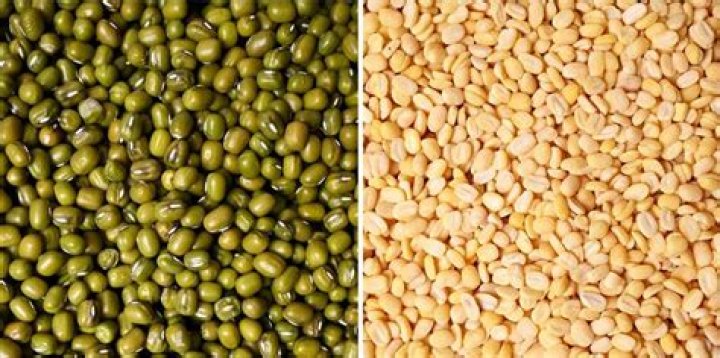
Essentially, yes, they are interchangeable.
Are yellow mung beans the same as yellow lentils?
Mung beans are not lentils and used to belong to the species that we commonly call bean but have been reclassified and so are no longer technically beans. Dal is often translated as “lentils” but actually refers to a split version of a number of lentils, peas, chickpeas (chana), kidney beans and so on.
What can I substitute for split mung beans?
Snow Peas or Pigeon Peas Trying to find a substitute for mung beans in cooking, many people substitute with pigeon peas or snow peas. Cooking with these provides a sturdy substitute to cooking with mung beans. They are commonly found in many grocery stores.
Is there another name for mung beans?
The mung bean (Vigna radiata), alternatively known as the green gram, maash (Persian: ماش), moong (from Sanskrit: मुद्ग, romanized: mudga), monggo, or munggo (Philippines), is a plant species in the legume family.
What is split mung beans?
The Split Mung Bean is a delicate legume that has been husked and split. It has a flavor similar to sweet and mild peas, and is often used as a protein source in Asian cuisines. Olive green to dark brown with yellow interior. Approximately 1/8 to 3/16 inches, split lengthwise. Half-ovals.
What is the difference between green and yellow mung beans?
Mung beans with the skin are green. Split mung beans without the skin are yellow. Green mung beans with the skin intact can be sprouted, while the hulled, split variety cannot.
Can I use whole mung beans instead of split?
What is this? Mung bean soup in instant pot & mung bean curry in instant pot using the whole green mung beans or green moong dal are so easy to prepare! The yellow mung beans also known as yellow moong dal can be whole or split, and they are most easy to cook.
Is mung bean yellow or green?
Mung beans can be purchased whole or split and hulled. They are delicate and slightly sweet in flavor and range in color from green to yellow to black. I am especially fond of the split, hulled variety, which I call the “mellow-yellow-mung.” In Indian cuisine, it is known as moong dhal.
What is the difference between yellow and green mung beans?
Mung beans with the skin are green. Split mung beans without the skin are yellow. Green mung beans with the skin intact can be sprouted, while the hulled, split variety cannot. We recommend split mung beans for those with weak digestion, and sprouted mung beans for improved nutrition if you can digest it without gas.
What can I substitute for split yellow mung beans?
You May Also Like
- Fava beans.
- Marrow beans.
- Cranberry bean.
- Rattlesnake beans.
How do you split mung beans?
Peel the green mung beans by soaking them overnight. Absorbed with water, their skin should be fairly easy to separate—simply by rubbing the beans gently in water. The skin will float to the top while the beans sink to the bottom. Drain the water with the floating skin to leave the peeled beans.
How long do mung beans take to sprout?
Mung bean sprouts are typically ready to harvest in three to five days and will grow to be about 1/2 inches in height. Depending on the quality of the seeds used, all of the seeds should produce sprouts.
How do you make sprouts from mung beans?
Mung beans can be sprouted by soaking dry whole beans in a jar of water for 8 to 10 hours under artificial light (not direct sunlight). After 8 to 10 hours, the water is drained from the jar and replaced with just enough water to cover the top of the beans and placed in a dark cupboard.
Are mung beans a vegetable?
MUNG BEANS. The mung bean is native to India, and is cultivated in China and much of Asia in general. This Asian vegetable plant was first grown in the U.S. in the late 19th century as a livestock feed. It is known by many names, including green gram, lutou, look dou, moyashimame, and oorud.
What is mung dal yellow?
Yellow mung dal is made from whole mung beans that have been hulled and split, resulting in a delicate lentil-like legume that is quick to cook and easy to digest.