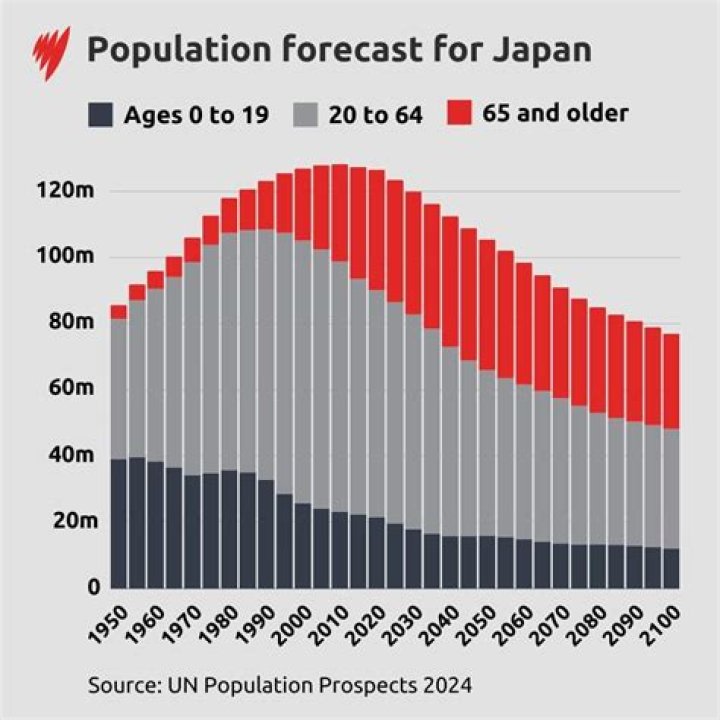
Based on the results of the medium-fertility projection, Japan is expected to enter a long period of population decline. The population is expected to decrease to around 110.92 million by 2040, fall below 100 million to 99.24 million by 2053, and drop to 88.08 million by 2065 (see Table 1-1 and Figure 1-1).
What is predicted about the Japanese population by 2110?
By 2110, the population under the medium fertility/medium mortality scenario is projected to be 53.4 million, down more than 70 million from the 2010 peak of 128 million (Figure 1). …
What is the projected fall of Japan’s population?
What will Japans population be in 2100?
Japan’s population is projected to have peaked in 2017 at 128 million, falling to 53 million by 2100. China’s population is expected to peak in 4 years at 1.4 billion, falling to 732 million in 2100.
What will the world’s population be in 2075?
7.85 billion
History of population projections In a 2004 long-term prospective report, the United Nations Population Division projected the world population would peak at 7.85 billion in 2075.
What is the population in Japan in 2021?
125,934,533
The current population of Japan is 125,934,533 as of Friday, November 26, 2021, based on Worldometer elaboration of the latest United Nations data.
What is the population of Russia 2021?
146,023,393
The current population of the Russian Federation is 146,023,393 as of Saturday, December 4, 2021, based on Worldometer elaboration of the latest United Nations data.
What is the current population growth rate of Japan?
From 1960 to 2019 the population of Japan increased from 92.50 m to 126.26 m people. This is a growth by 36.5 percent in 59 years. The highest increase in Japan was recorded in 1961 with 2.64%. The biggest decrease in 2019 with -0.21%.
What factors affect Japan’s population growth?
Factors Influencing Japan’s Population Lifestyle. The shift in Japan’s population can be partially attributed to lifestyle choices. Aging Population. It has been predicted that by 2025, 27.3 percent of Japan’s population will be over the age of 60. Economy. Effects of Depopulation.
What is the population problem in Japan?
Japan’s population is aging and declining . Two main forces are responsible: declining fertility rates and lengthening life spans: 1. Fewer babies. A total fertility rate of 2.1 would keep a population stable, assuming no migration. Japan hit this level in 1960, falling persistently below since 1975.
Why is Japan’s population declining?
Japan population is decreasing because children come with a lot of responsibilities and maintenance whereas pets are easy to take care of. Japan’s population is declining year after year. 2019 was the end of the Heisei era that spanned for 30 years in Japan. During this period, the country became one of the most ageing societies.