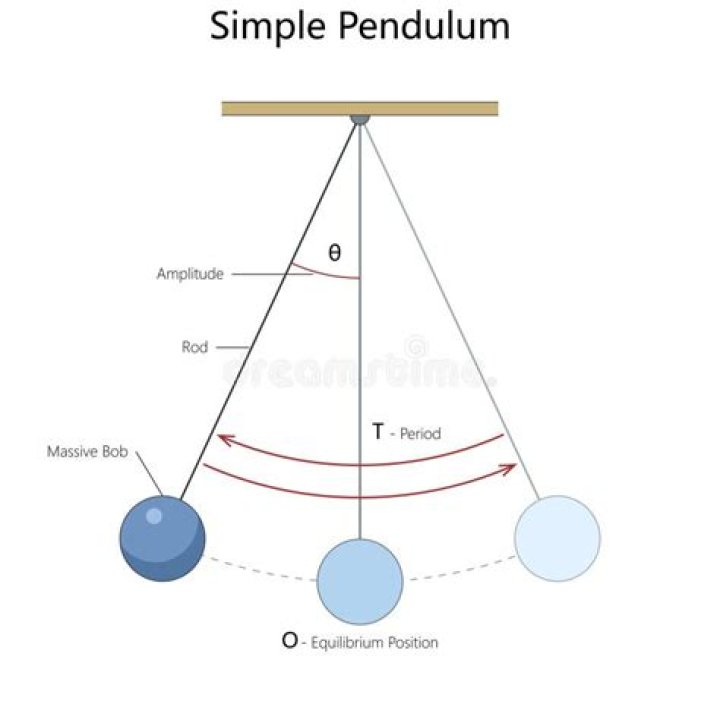
The kinetic energy will decrease as the bob moves away from the equilibrium position. Where is the maximum kinetic energy in a pendulum? At the equilibrium position, kinetic energy will be maximum since velocity is the maximum at this point.
How do you find the maximum kinetic energy?
The maximum kinetic energy of a photoelectron is given by 𝐸 = ℎ 𝑓 − 𝑊 , m a x where ℎ is the Planck constant, 𝑓 is the frequency of the incident photon, and 𝑊 is the work function of the metal surface.
Which has the maximum kinetic energy?
While in case of gases, the particles are most free to move as they are loosely packed and thus gases possess maximum kinetic energy.
Where do you find maximum Ke and maximum PE in case of a swinging pendulum?
As a pendulum swings it is constantly exchanging kinetic and gravitational energy. At the top of each swing the pendulum has zero velocity, therefore zero K.E. and its gravitational P.E. is clearly at a maximum. At the lowest point it is moving fastest and so has its maximum K.E.
How do you find the maximum kinetic energy of a spring?
From calculus, the formula is (0.5)kx^2, where x^2 is the square of the initial displacement of the end of the spring. The kinetic and potential energy at any point will sum to this value. Identify the spring’s maximum kinetic energy, at the equilibrium point, as equal to the initial potential energy.
Where will you find the maximum kinetic energy of the bob of a swinging pendulum *?
Kinetic energy of the bob of a simple pendulum is maximum at the extreme left position.
Where does a pendulum have maximum potential energy and kinetic energy?
The potential energy of an oscillating pendulum is maximum at its extreme positions. In this position the pendulum bob has zero velocity. Hence, all its total energy at this position is the potential energy. The kinetic position of the pendulum is maximum at the mean position.
Is maximum kinetic energy equal to maximum potential energy?
At an object’s maximum height, kinetic energy is zero/ maximum while the potential energy is zero/ maximum.
How do you find the maximum kinetic energy of emitted electrons?
The maximum kinetic energy KEe of ejected electrons (photoelectrons) is given by KEe = hf − BE, where hf is the photon energy and BE is the binding energy (or work function) of the electron to the particular material.
What is the maximum kinetic energy of the bob?
The bob of a pendulum has maximum kinetic energy at the mean position. The total energy at any point remains constant. At the lowest point, Potential energy is zero. So the entire energy is in form of K.E.. Hence K.E. is maximum at the lowest (mean) point.
Where does the pendulum have maximum?
The maximum potential energy is at the extreme positions and the maximum kinetic energy is at the mean position.
What is the kinetic energy of a simple pendulum?
The kinetic energy of the pendulum is given as K.E = (1/2) mv 2 At the highest point, the kinetic energy is zero and it is maximum at the lowest point. However, the total energy is constant as the function of time. In a simple pendulum, the mechanical energy of the simple pendulum is conserved.
When does the maximum velocity of a pendulum bob occur?
In keeping with the earlier discussion of kinetic and potential energy, the maximum velocity of a pendulum bob occurs at the moment it is pointing straght down, when it has the most kinetic energy. The equation for maximum velocity: Note: This is a multi-page article.
What is the formula for simple pendulum?
Time Period of Simple Pendulum Derivation Using the equation of motion, T – mg cosθ = mv 2 L The torque tending to bring the mass to its equilibrium position, τ = mgL × sinθ = mgsinθ × L = I × α
How does mass affect the period of a pendulum?
All of the mechanical energy eventually becomes other forms of energy such as heat or sound. Your investigations should have found that mass does not affect the period of a pendulum. One reason to explain this is using conservation of energy.